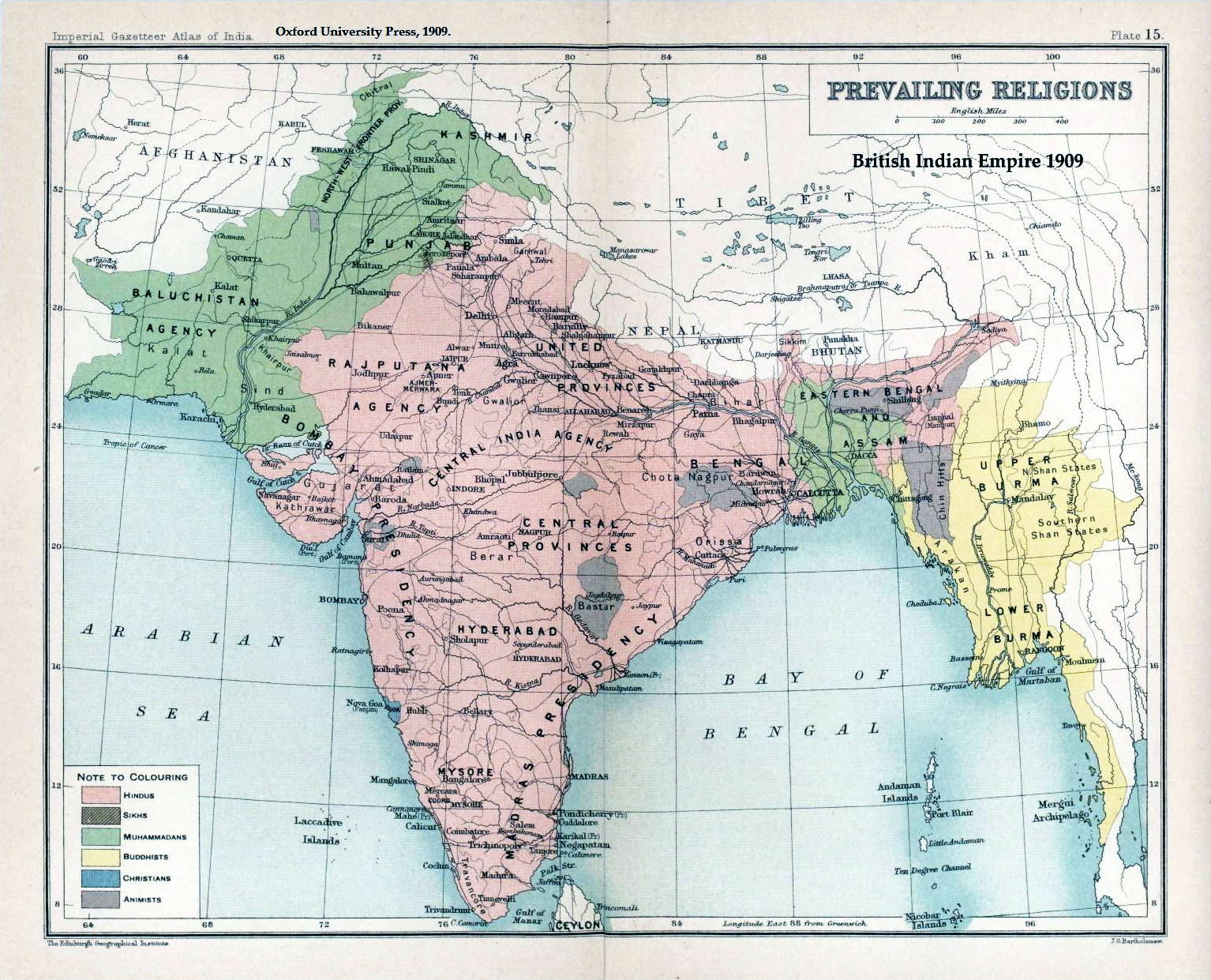
On a quiz, some students listed Burma, Nepal, and Sri Lanka as countries which emerged from British India, rather than the expected answer of India, Pakistan, and Bangladesh. Are these answers acceptable? According to this source (as well as many others), "British rule in Burma lasted from 1824 to 1948, Britain made Burma a province of India in 1886, and the British separated Burma Province from British India in 1937." Burma is therefore technically an acceptable answer. However, Nepal simply negotiated and allied itself with the British. It was never a British colony, although it was strongly influenced by the British. Sri Lanka, once known as Ceylon, was considered and administered separately from India, so it can not be said to have "emerged from India." Sorry!
Showing posts with label imperialism. Show all posts
Showing posts with label imperialism. Show all posts
Thursday

Sunday
More about the end of empire--decolonization
 In our Unit 8 readings about empire, (and the end of an era of imperialism and colonialism) we learned a little about British India and the independence of India. Nehru was the first prime minister of India and the longest-serving one. Having 14 prime ministers in 62 years means an average term has been over 4 years, but some prime ministers have served longer and others much shorter terms. Nehru's daughter, Indira Gandhi, and Nehru's grandson, Rajiv Gandhi, were also prime ministers. Both were killed on-the-job. Aside from these members of the Nehru-Gandhi family (no relation to Mohandas Gandhi), other long-serving prime ministers were Rao, Vajpayee, and Singh. The heir to the Nehru political dynasty, Rajiv Gandhi's widow, Italian-born Sonia Gandhi, has remained behind-the-scenes as the National Congress Party leader and has not sought to become prime minister herself.
Nehru's speech alludes to the conflicts arising from the partition of India. Relations with Pakistan are often tense, and war has broken out many times. India's takeover of Goa from the Portuguese in 1961 and the Indo-China War in 1962 were two events that show how different Nehru was from independence leader Gandhi.
Thursday
International Relations: End of Empire (Unit 8)
Our reading is The Birth of Modern India: A Tryst with Destiny, a speech by Nehru on August 14, 1947, the eve of independence. (India became independent on August 15.) You can watch and listen to part of Nehru's speech to see what it looked and sounded like.
How much do you know about the British Empire?
Syllabus (2009)
This is the syllabus for 2009. It's not the same as the current year.

 English II (Readings in Social Issues)
Waseda University
Spring 2009
Goals and Objectives:
In the opinion of many, reading is the single most important skill required for a thorough education. The course aims not only to familiarize students with some of the key issues and vital terminology of politics and economics, but also to provide them with an opportunity to tackle a variety of language practices and discussion activities. Students will be expected both to read the book and to play an active part in class discussion, using the texts as a springboard to deeper consideration of the important topics that arise.
Textbook: World Views: English for Political Science and Economics (Waseda University Press)
This book covers five significant themes: globalization; the environment; international relations; society and culture; and perspectives on Japan. All the materials are completely authentic, having been drawn from newspapers, academic textbooks, and famous speeches of the past
Grading:
_ Attendance 35%;
_Participation 15%;
_Assignments 25%;
_ Exams 25%
Weekly Lesson Plan:
We meet twice a week, on Monday and Thursday. The lesson plans belowmay change a little. There may be unplanned “pop” quizzes and other assignments. Additional readings may also be assigned.
Class
Date
Lesson plan
#1
April 6
(All levels) Introduction to the course
#2
April 9
Unit 1 Introduction; Your Views (1); Focus on Language.
HW: Read Unit 1 text
#3
April 13
Review of homework and vocabulary; Shared Views (1); Expanded Views (1)
#4
April 16
Unit 2 Introduction; Your Views (2); Focus on Language.
HW: Read Unit 2 text
#5
April 20
Review of homework and vocabulary; Shared Views (2); Expanded Views (2)
#6
April 23
“Toward a Greener Future” – extension
#7
April 27
Unit 3 Intro; Your Views (3); Focus on Language.
HW: Read Unit 3 texts
#8
May 7
Review of homework and vocabulary; Shared Views (3); Expanded Views (3)
#9
May 11
“The Cold War and Its Aftermath” – extension
#10
May 14
Unit 4 Introduction; Your Views (4); Focus on Language.
HW: Read Unit 4 texts
#11
May 18
Review of homework and vocabulary; Shared Views (4); Expanded Views (4)
#12
May 21
“Old Ways, New Ways” – extension
#13
May 25
Unit 5 Introduction; Your Views (5); Focus on Language.
HW: Read Unit 5 text
#14
May 28
Review of homework and vocabulary; Shared Views (5); Expanded Views (5)
#15
June 1
Midsemester Review; Q & A session
#16
June 4
Unit 6 Introduction; Your Views (6); Focus on Language.
HW: Read Unit 6 text
#17
June 8
Review of homework and vocabulary; Shared Views (6); Expanded Views (6)
#18
June 11
“Two Sides of the Same Coin” – extension
#19
June 15
Unit 7 Introduction; Your Views (7); Focus on Language.
HW: Read Unit 7 text
#20
June 18
Review of homework and vocabulary; Shared Views (7); Expanded Views (7)
#21
June 22
“Currents of Interest” – extension
#22
June 25
Unit 8 Introduction; Your Views (8); Focus on Language.
HW: Read Unit 8 texts
#23
June 29
Review of homework and vocabulary; Shared Views (8); Expanded Views (8)
#24
July 2
“End of Empire” – extension
#25
July 6
Unit 9 Introduction; Your Views (9); Focus on Language.
HW: Read Unit 9 texts
#26
July 9
Review of homework and vocabulary; Shared Views (9); Expanded Views (9)
#27
July 13
“Aging Gracefully” – extension
#28
July 16
Unit 10 Introduction; Your Views (10); Focus on Language.
HW: Read Unit 10 texts
#29
July 20
Review of homework and vocabulary; Shared Views (10); Expanded Views (10)
#30
July 23
FINAL REVIEW; Q & A session; concluding remarks
Subscribe to:
Posts (Atom)