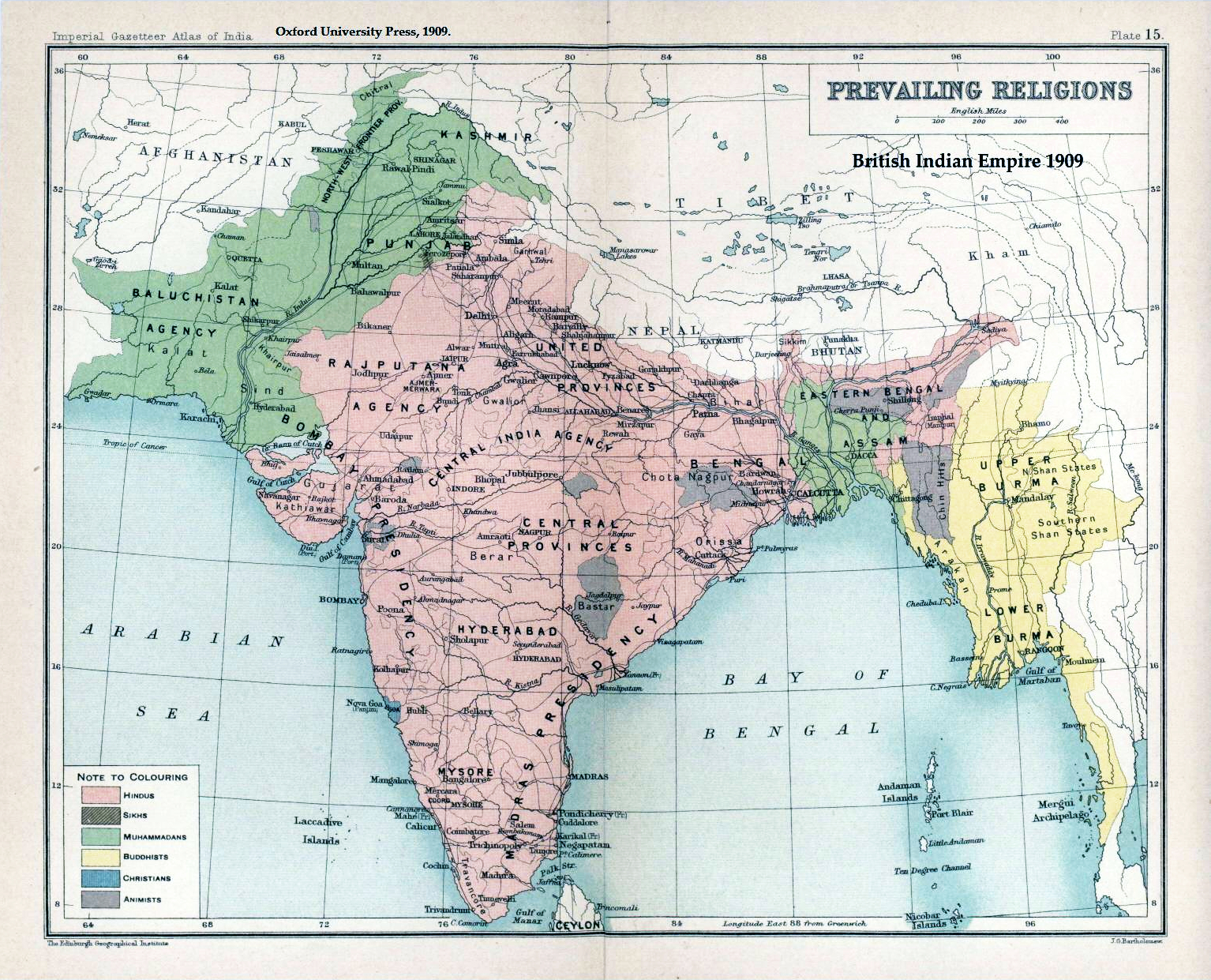
On a quiz, some students listed Burma, Nepal, and Sri Lanka as countries which emerged from British India, rather than the expected answer of India, Pakistan, and Bangladesh. Are these answers acceptable? According to this source (as well as many others), "British rule in Burma lasted from 1824 to 1948, Britain made Burma a province of India in 1886, and the British separated Burma Province from British India in 1937." Burma is therefore technically an acceptable answer. However, Nepal simply negotiated and allied itself with the British. It was never a British colony, although it was strongly influenced by the British. Sri Lanka, once known as Ceylon, was considered and administered separately from India, so it can not be said to have "emerged from India." Sorry!
Showing posts with label Britain. Show all posts
Showing posts with label Britain. Show all posts
Thursday

Sunday
More about the end of empire--decolonization
 In our Unit 8 readings about empire, (and the end of an era of imperialism and colonialism) we learned a little about British India and the independence of India. Nehru was the first prime minister of India and the longest-serving one. Having 14 prime ministers in 62 years means an average term has been over 4 years, but some prime ministers have served longer and others much shorter terms. Nehru's daughter, Indira Gandhi, and Nehru's grandson, Rajiv Gandhi, were also prime ministers. Both were killed on-the-job. Aside from these members of the Nehru-Gandhi family (no relation to Mohandas Gandhi), other long-serving prime ministers were Rao, Vajpayee, and Singh. The heir to the Nehru political dynasty, Rajiv Gandhi's widow, Italian-born Sonia Gandhi, has remained behind-the-scenes as the National Congress Party leader and has not sought to become prime minister herself.
 Nehru's speech alludes to the conflicts arising from the partition of India. Relations with Pakistan are often tense, and war has broken out many times. India's takeover of Goa from the Portuguese in 1961 and the Indo-China War in 1962 were two events that show how different Nehru was from independence leader Gandhi.
Thursday
International Relations: End of Empire (Unit 8)
Our reading is The Birth of Modern India: A Tryst with Destiny, a speech by Nehru on August 14, 1947, the eve of independence. (India became independent on August 15.) You can watch and listen to part of Nehru's speech to see what it looked and sounded like.
How much do you know about the British Empire?
Differences between British and American English
As you are probably aware, Americans and Britons speak the same language, but there are many small yet significant differences between British and American English. One of the most visible differences is spelling, which is often different due to the influences of early American dictionary publishers. A nice list of spelling differences by type is here.
Differences in word usage sometimes requires "translation" or the creation of local versions for British and American software, books, and other materials. Note this list by the Ubuntu (Linux operating system) team.
You may enjoy reading the British English Glossary or this (course) outline of differences. An interesting quote from that outline is:
American and British English are both variants of World English.
Friday
Unit 3--The Cold War and its Aftermath
Unit 3--The Cold War and its Aftermath
View YouTube clip (5:15) of Winston Churchill's speech with "Iron Curtain" here
or
http://www.winstonchurchill.org/i4a/pages/index.cfm?pageid=429
or
http://www.americanrhetoric.com/speeches/winstonchurchillsinewsofpeace.htm
Text with RealAudio
http://www.hpol.org/churchill/
Winston Churchill speeches in the Internet Public Archive
http://www.archive.org/details/Winston_Churchill
13MB MP3
http://www.archive.org/download/Winston_Churchill/1946-03-05_BBC_Winston_Churchill_The_Sinews_Of_Peace.mp3
Extensive Background Reading material
http://en.wikipedia.org/wiki/Iron_Curtain
http://en.wikipedia.org/wiki/Cold_war
http://en.wikipedia.org/wiki/Revolutions_of_1989
Another Cold War metaphor from this side of the Iron Curtain:
 What was the atmosphere of growing up in the Cold War?
You may find it interesting to watch the 1951 film "Duck and Cover," which trained schoolchildren to survive nuclear attack.
http://www.archive.org/details/DuckandC1951
This is a very popular film in the Prelinger Film Archives. Why?
You could also see Atomic Alert (produced by the Encyclopedia Britannica), also from 1951
http://www.archive.org/details/AtomicAl1951
Our Cities Must Fight (1951)
This film encouraged citizens to not flee, to remain in the cities to fight, even after a nuclear war.
http://www.archive.org/details/OurCitie1951
You can see from these films that by 1951 the Cold War (Or Hot Peace?) was at a high level of fear, paranoia, propaganda, and hysteria.
Have a look at another great public speaker from the middle of the Cold War period, American civil rights leader Martin Luther King.
"I have a Dream" 1963-08-28
http://www.youtube.com/watch?v=PbUtL_0vAJk
Read the transcript
http://www.mlkonline.net/dream.html
Download in various formats
http://www.archive.org/details/MLKDream
VOA Special English news reports/remembers MLK
http://www.voanews.com/english/Martin-Luther-King-Jr-Remembered.cfm
How about something much more recent? Is Barack Obama a great public speaker? Watch and decide.
The Inauguration of Barack Obama 2009-01-20
http://www.youtube.com/watch?v=3PuHGKnboNY
View YouTube clip (5:15) of Winston Churchill's speech with "Iron Curtain" here
or
http://www.winstonchurchill.org/i4a/pages/index.cfm?pageid=429
or
http://www.americanrhetoric.com/speeches/winstonchurchillsinewsofpeace.htm
Text with RealAudio
http://www.hpol.org/churchill/
Winston Churchill speeches in the Internet Public Archive
http://www.archive.org/details/Winston_Churchill
13MB MP3
http://www.archive.org/download/Winston_Churchill/1946-03-05_BBC_Winston_Churchill_The_Sinews_Of_Peace.mp3
Extensive Background Reading material
http://en.wikipedia.org/wiki/Iron_Curtain
http://en.wikipedia.org/wiki/Cold_war
http://en.wikipedia.org/wiki/Revolutions_of_1989
Another Cold War metaphor from this side of the Iron Curtain:
In 1983, Japanese Prime Minister Yasuhiro Nakasone pledged to make Japan an "unsinkable aircraft carrier in the Pacific", assisting the U.S. in defending against the threat of Soviet bombers.
 What was the atmosphere of growing up in the Cold War?
You may find it interesting to watch the 1951 film "Duck and Cover," which trained schoolchildren to survive nuclear attack.
http://www.archive.org/details/DuckandC1951
This is a very popular film in the Prelinger Film Archives. Why?
You could also see Atomic Alert (produced by the Encyclopedia Britannica), also from 1951
http://www.archive.org/details/AtomicAl1951
Our Cities Must Fight (1951)
This film encouraged citizens to not flee, to remain in the cities to fight, even after a nuclear war.
http://www.archive.org/details/OurCitie1951
You can see from these films that by 1951 the Cold War (Or Hot Peace?) was at a high level of fear, paranoia, propaganda, and hysteria.
Have a look at another great public speaker from the middle of the Cold War period, American civil rights leader Martin Luther King.
"I have a Dream" 1963-08-28
http://www.youtube.com/watch?v=PbUtL_0vAJk
Read the transcript
http://www.mlkonline.net/dream.html
Download in various formats
http://www.archive.org/details/MLKDream
VOA Special English news reports/remembers MLK
http://www.voanews.com/english/Martin-Luther-King-Jr-Remembered.cfm
How about something much more recent? Is Barack Obama a great public speaker? Watch and decide.
The Inauguration of Barack Obama 2009-01-20
http://www.youtube.com/watch?v=3PuHGKnboNY
Thursday
Juries in Japan (Unit 10-related readings)
A new jury system in Japan is changing the way the country tries criminals. Six citizen judges will now decide the fate of those accused of violent crimes instead of professional judges alone. It is the first major overhaul to the country's legal system in more than 60 years. The new system has not been tested in trial yet but it is already causing a debate.When suspected murderer Katsuyoshi Fujii takes the stand in his trial next month, public attention may focus not be on the 72-year-old but on the jurors deciding his fate. Six people will be called to hear testimony in the case. At the end of the trial, those six will become the first citizen judges to reach a verdict in Japan since World War II.Defense attorney Satoru Shinomiya will be among a group of lawyers watching the case closely."The aim of justice reform is to make our society more free, more fair, and more responsible," said Shinomiya.Citizen judge systemShinomiya has been pushing for the "Saiban-in" or citizen judge system for years, and calling for more transparency in the judicial process."They say that I am the most optimistic person in the bar but I really do believe in the people," said Shinomiya.Japan abolished its jury system during World War II, and cases have been decided by a panel of professional judges.The current system gives prosecutors extensive powers, but defense attorneys argue those powers go to far too far. Prosecutors are allowed to detain and interrogate a suspect for 23 days, without a defense attorney present, and force them to makewritten statements and confessions. Nearly 100 percent of indictments resulted in convictions.Makoto Miyazaki, the president of the country's bar association describes those cases as "hostage trials" where suspects were detained until they confessed.He says that anyone who has witnessed trials in Japan knows that they are not trials where lawyers and prosecutors debate the facts. It is simply a forum for prosecutors to hand over documents to the judge.That criticism has grown louder since a 62-year-old man who was wrongly convicted was released from prison last month. Toshikazu Sugaya served 17 years behind bars for the murder of a young girl. He said prosecutors forced him to confess to a crime he did not commit. He was freed after a new test revealed his DNA did not match that on the victim's body."If the 'Saiban-in' were there, at least they would have listened to the argument seriously, carefully," said Sugaya.Legal processSix jurors will now decide cases involving serious, violent crimes. Three professional judges will work with them to guide them through the legal process. Jurors will be chosen randomly from voter registration rolls, although politicians, legal professionals, the elderly and students will be exempt from serving.The hope is this new process will increase understanding of the country's judicial system, keep prosecutors in check, and promote civic responsibility.Former Supreme Court Judge Kunio Hamada says it forces Japanese to think independently."This is a great social experience," said Hamada. "Hopefully by going through this process there will be more Japanese citizens capable of formulating their opinion in international scenes."But potential jurors are not exactly eager to give those opinions. Polls conducted in April showed about half of the public did not want to serve. Hamada says that is not surprising in a society that does not promote independence. He says people often worry about public opinion and do not like to separate from the pack.More than 130 suspects are scheduled to stand trial under the new system. But those who supported it are already pushing for more changes. They want police interrogations video-taped and checks in place to make sure judges do not influence jurors in deliberation rooms.They also want to require jurors to give a unanimous decision. The Saiban-in law only requires a majority opinion to decide cases, including death penalty cases. That means debate about the new system is likely to continue even after the first jury trial begins.

Here are some related pages:
The Wikipedia page for Jury Trials tells about the international and historical status of jury trials from ancient Athens to Australia, Austria, Belgium, Canada, France, Germany, Greece, Gibraltar, India, Ireland, Italy, New Zealand, Russia, and Switzerland.
The Ministry of Justice explains jury trials with an animation.
Subscribe to:
Posts (Atom)


.gif)