Thursday
Unit 10: Japan: Justice: Zooming in on Public Security
The original source text of the article is at http://search.japantimes.co.jp/cgi-bin/nn20070810f1.html. There, you can see the article in context, with photos. However, the textbook has been updated, and provides vocabulary, notes, a glossary, and mp3 for listening. The blog of David Murakami Wood, the surveillance researcher and expert cited in the article, is at http://ubisurv.wordpress.com/.
Monday
Aging Gracefully (Unit 9)
 The original article, Growing Old, Baby Boomer Style by Tom Valleo can be read online here at WebMD and here at CBS News. It was originally published in 2006. Some things have certainly changed since it was written, such as the predicted worker shortage of 2010.
[Click on the population pyramid on the left to see an animated projection of Japan's past and future population.]
In Japan, Seniors With an Edge was published in 2007 by the NYT. You may need to log in to the NYT to read it online, or read Google's cache of the page.
Read more at Japan's National Institute of Population and Social Security Research. Be sure to see the animated population pyramid for Japan. They have a full report of Japan's population statistics (pdf).
The demographic transition to a stable industrial population is a centuries-long process that is ongoing in much of the world now.
Note that there are about four million births in the United States annually–only slightly below the peak years of the 1946-1964 Baby Boom.
The U.S. Census Bureau has a database of population information about many other countries of the world, too.
What is the population of the world? Over 6.8 billion in 2010!
Geohive, CensusScope, and the Population Reference Bureau
 The Population Reference Bureau is a great site for finding population and statistical information and displaying it. For example, you can find and display the senior fraction of the population, or see a map that displays the projected percentage change in population from 2008-2050. Try visiting the DataFinder part of the site and click on World>Population Trends or World>Economic.
 CensusScope is a similar data tool, but it is focused on the United States. The U.S. Age Distribution (or Population Pyramid) i

Geohive is more global-minded than CensusScope, but doesn't have as many graphs, charts, and maps as DataFinder. It still has some unique displays. When will India's population growth push it past China? Around 2030, if the projections are correct. Which countries have the largest populations? Japan is still barely in the top 10, but not for long. Which countries have the largest land area?

Thursday
India became…?
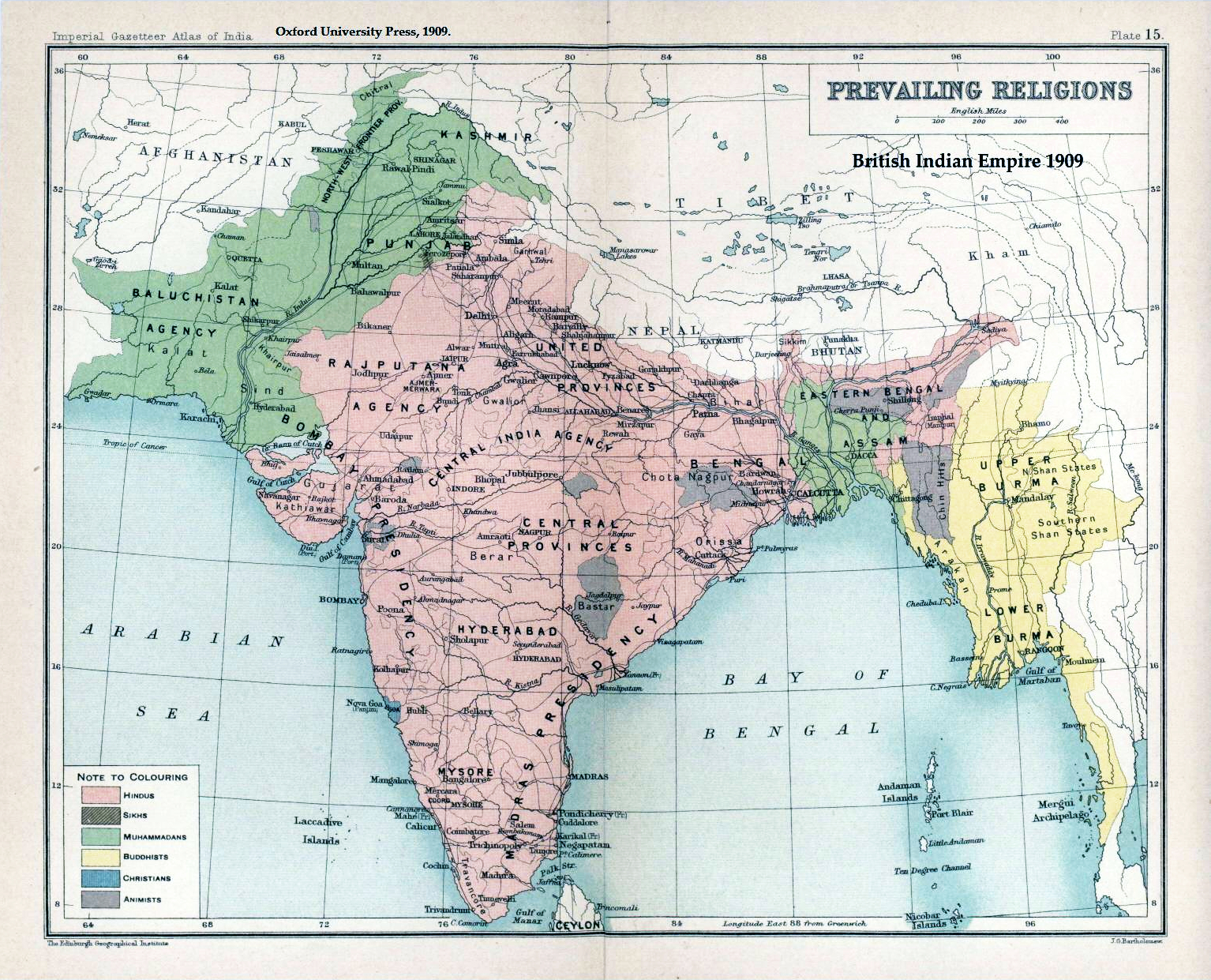
On a quiz, some students listed Burma, Nepal, and Sri Lanka as countries which emerged from British India, rather than the expected answer of India, Pakistan, and Bangladesh. Are these answers acceptable? According to this source (as well as many others), "British rule in Burma lasted from 1824 to 1948, Britain made Burma a province of India in 1886, and the British separated Burma Province from British India in 1937." Burma is therefore technically an acceptable answer. However, Nepal simply negotiated and allied itself with the British. It was never a British colony, although it was strongly influenced by the British. Sri Lanka, once known as Ceylon, was considered and administered separately from India, so it can not be said to have "emerged from India." Sorry!
Sunday
More about the end of empire--decolonization
 In our Unit 8 readings about empire, (and the end of an era of imperialism and colonialism) we learned a little about British India and the independence of India. Nehru was the first prime minister of India and the longest-serving one. Having 14 prime ministers in 62 years means an average term has been over 4 years, but some prime ministers have served longer and others much shorter terms. Nehru's daughter, Indira Gandhi, and Nehru's grandson, Rajiv Gandhi, were also prime ministers. Both were killed on-the-job. Aside from these members of the Nehru-Gandhi family (no relation to Mohandas Gandhi), other long-serving prime ministers were Rao, Vajpayee, and Singh. The heir to the Nehru political dynasty, Rajiv Gandhi's widow, Italian-born Sonia Gandhi, has remained behind-the-scenes as the National Congress Party leader and has not sought to become prime minister herself.
 Nehru's speech alludes to the conflicts arising from the partition of India. Relations with Pakistan are often tense, and war has broken out many times. India's takeover of Goa from the Portuguese in 1961 and the Indo-China War in 1962 were two events that show how different Nehru was from independence leader Gandhi.
Thursday
International Relations: End of Empire (Unit 8)
Our reading is The Birth of Modern India: A Tryst with Destiny, a speech by Nehru on August 14, 1947, the eve of independence. (India became independent on August 15.) You can watch and listen to part of Nehru's speech to see what it looked and sounded like.
How much do you know about the British Empire?
Differences between British and American English
As you are probably aware, Americans and Britons speak the same language, but there are many small yet significant differences between British and American English. One of the most visible differences is spelling, which is often different due to the influences of early American dictionary publishers. A nice list of spelling differences by type is here.
Differences in word usage sometimes requires "translation" or the creation of local versions for British and American software, books, and other materials. Note this list by the Ubuntu (Linux operating system) team.
You may enjoy reading the British English Glossary or this (course) outline of differences. An interesting quote from that outline is:
American and British English are both variants of World English.
Monday
"Blue Gold: World Water Wars" & "FLOW"
There is a documentary movie about water issues. It is called Blue Gold: World Water Wars. Here is the movie trailer.

Wars of the future will be fought over water as they are over oil today, as the source of human survival enters the global marketplace and political arena. Corporate giants, private investors, and corrupt governments vie for control of our dwindling supply, prompting protests, lawsuits, and revolutions from citizens fighting for the right to survive. Past civilizations have collapsed from poor water management. Can the human race survive?
Director Sam BozzoThe movie was released in Japan in January 2010. You can order the DVD, or you could download the movie as a BitTorrent -- with the understanding of the director!
Another 2008 documentary, Flow: For the Love of Water, also discusses the same issues, focusing on the privatization of water. The film was on TV in Japan on November 1, 2009. DVDs are also available.
You can read more about the water crisis and water politics (also known as hydropolitics) in these Wikipedia articles, which give a useful overview.
We don't use water in only the obvious ways. It also takes a lot of water to make food and other things we use. If we consider this "virtual water," then Japan is one of the world's biggest water users, as this map shows. Here are some tips for saving water.
Sunday
Thursday
Whales help reduce carbon dioxide
Research by Trish Lavery at Flinders University has shown that by feeding in deep waters and defecating in surface waters, whales cycle iron and other nutrients to where they can be used for photosynthesis, helping absorb carbon dioxide. The research has been published in the Proceedings of the Royal Society and re-published in the popular magazine Scientific American and been the subject of radio and television news reports. Even the Sea Shepherd Conservation Society quickly publicized the news with an editorial praising whale excrement.
In other whale news, the German magazine Spiegel Online has an article on whaling, with an accompanying photo gallery, and TIME magazine has had some commentary on the issue as it is recently in the news. Australia is taking Japan to the World Court and Japan is starting its northern hemisphere whaling season.
Monday
Wars for Water? (Unit 7--The Environment: Currents of Interest)
The article by Michael Klare was originally published in Newsweek.You can find another copy of it here.
Although the Newsweek article is positive about the chances for peace and international cooperation, Professor Klare seems to make the opposite points in some of his video-blogging at Big Think.
Listen to this.
Hey! Look! Joseph Stiglitz is on Big Think, too!
Although the Newsweek article is positive about the chances for peace and international cooperation, Professor Klare seems to make the opposite points in some of his video-blogging at Big Think.

Listen to this.

Hey! Look! Joseph Stiglitz is on Big Think, too!
Friday
Quantifying Peace
 This page (Global Conflict Trends: Measuring Systemic Peace) has a collection of interesting data and figures (graphs) showing the condition of war and intrastate violence in the world. It's very easy to understand, especially if you enjoy seeing data depicted in graph or chart form. It's at this site, the Center for Systemic Peace, affiliated with the Center for Global Policy at George Mason University.
Thursday
Amartya Sen
The Nobel-prize winning economist says that the present economic crisis will end America's dominance as a world leader.
Joseph E. Stiglitz
[Stiglitz's autobiography at nobelprize.org]
[His homepage at Columbia University]
[Wikipedia entry]
In this 2002 interview he criticizes the policies of the IMF and World Bank.
Sunday
From GDP to Gross National Happiness
The current global economic crisis is causing a lot of reconsideration and re-examination of past practices and theories. French President Sarkozy fromed a commission including Nobel-Prize-winners Amartya Sen and Joseph Stiglitz to consider new ways to measure growth. Their report was released September 2009.
www.france24.com
www.france24.com
New York Times
Here is a related video from December 11, 2009: the Kenneth Arrow lecture by Amartya Sen, including a response by Joseph Stiglitz. It's very very very long, but it gives you an idea of how Amartya Sen speaks and looks.
Here is a related video from December 11, 2009: the Kenneth Arrow lecture by Amartya Sen, including a response by Joseph Stiglitz. It's very very very long, but it gives you an idea of how Amartya Sen speaks and looks.
Annual Kenneth Arrow Lecture Featuring Amartya Sen, Joseph Stiglitz, and Eric Maskin, Part 1 of 3 from Heyman Center for the Humanities on Vimeo.
Thursday
Unit 6--Globalization: Two Sides of the Same Coin

An earlier post had a link to a short encyclopedia article on globalization. Unit 6 is a difficult read, but you will find many of the same arguments discussed in the book are repeated in this longer encyclopedia article --and a Japanese version is available. The introduction of Wayne C. McWilliams and Harry Piotrowski's popular textbook, The World Since 1945, is available as a pdf at the publisher's website. An excerpt:
Meanwhile, both superpowers began rearming, and a relentless arms race was soon under way. Each claimed that security—both national and global—lay in military strength, but that the other’s armaments threatened world peace. Thus they justified the building of massive arsenals containing thousands of nuclear weapons far more powerful than the ones used against Japan in 1945. Their arsenals have long since been large enough to destroy each other many times over and possibly extinguish human life on this planet, and yet year after year they continued piling up more weapons, spending at a rate of millions of dollars per day. When they decided to scale back their nuclear arsenals, they found out that the genie was already out of the bottle, that even poor Third World nations had the capability to build and launch them.The military standoff between the nuclear powers brought about a precarious truce between them, but the rest of the world was not free of war. On the contrary, there have been more than one hundred wars since World War II, and many of these lesser wars, though contained geographically and limited to conventional weapons, carried the potential of igniting a larger conflagration. Indeed, the combatants were all too often clients of the major powers and were armed by them.Equally dangerous to the safety and well-being of humanity was the growing gulf between the world’s rich and poor, between the industrially advanced nations of the North and the underdeveloped nations of the South. In the South, often referred to as the Third World, one finds the world’s lowest standards of living, lowest economic growth rates, lowest levels of education, lowest rates of life expectancy, and the highest population growth rates and infant mortality rates. Thus, millions of the inhabitants of the Third World are dreadfully impoverished, malnourished, disease-ridden, and unable to live productively and in dignity. Governments of Third World nations struggled, usually ineptly, to lift their countries from such impoverishment, and while some have made marginal progress, many others were merely marking time or slipping even further behind. Many of these countries contracted enormous foreign debts they were unable to pay, and their indebtedness threatened the financial stability of the wealthier nations of the North. Economic failure made the Third World more volatile politically and more vulnerable to intervention and militarization by the superpowers. Nearly every war fought since World War II was fought in Third World countries, and all were fought with weapons supplied by industrialized nations.
You should know a little about the IMF (International Monetary Fund), The World Bank (Wikipedia) The Washington Consensus, The 1997 Asian Currency Crisis, anti-globalization movements, and the main criticisms of globalization. Note that globalization of a sort has been going on for thousands of years (e.g. the Silk Road), and that periods of globalization has alternated with periods of deglobalization, periods when the international flow of people, goods, and money has slowed down.

In the current financial and economic crisis, the largest since the 1930s, our understanding and attitudes toward the financial institutions which caused the crisis, the Washington Consensus, the IMF, and the World Bank may be changing. Some observers have called this the collapse of American capitalism, comparable to the collapse of communism. Time will tell. Others have pointed out that the official response to the crisis in the United States is quite different--even opposite--to the economic austerity that the IMF imposed on the Asian countries in the 1997 currency crisis. Is it hypocrisy or is the US economy so different that it requires different measures to recover?
Tuesday
A whale of a problem
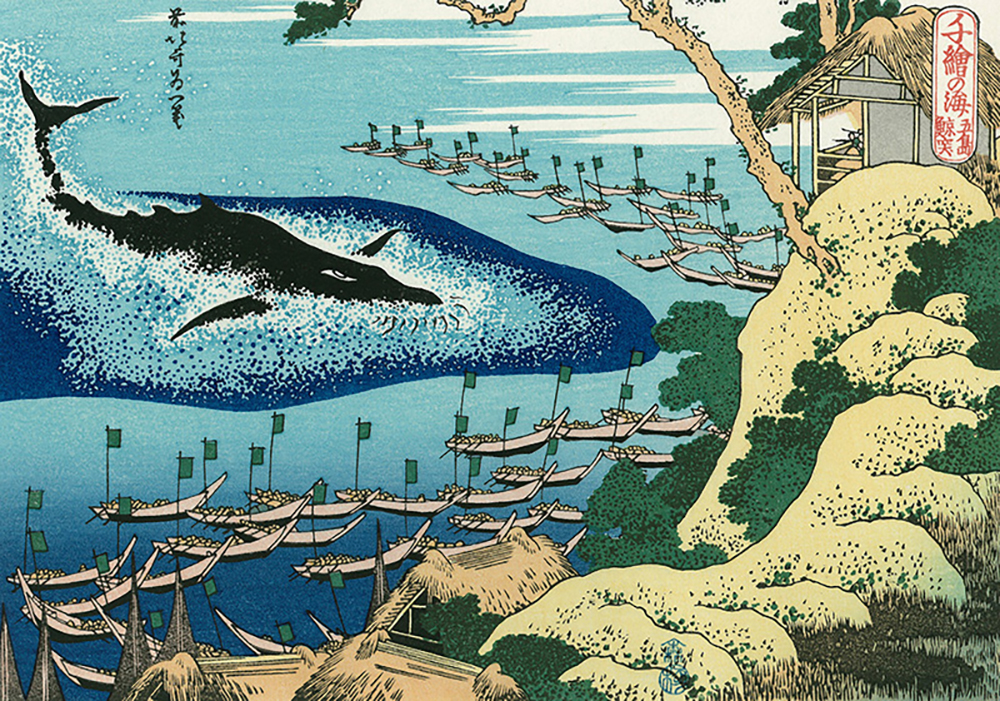 If we are going to discuss whaling in modern Japan, it's useful to know as much as possible about whales, and other cetaceans. Are they intelligent? Are they highly evolved? Are they endangered?
You can read about some general background information about whaling:
http://en.wikipedia.org/wiki/Whaling
This is the site of Japan's ICR (Institute of Cetacean Research). Controversially, their "research" involves killing and eating whales.
http://www.icrwhale.org/abouticr.htm
Here is the Wikipedia article on the ICR.
http://en.wikipedia.org/wiki/Institute_of_Cetacean_Research
The International Whaling Commission (IWC) has a website that includes current population estimates, sounds, and other information. You could also read about the IWC from the Wikipedia, from the World Wildlife Fund (WWF), and from the Humane Society.
Greenpeace reports on Japanese whaling on their web site, and Greenpeace Japan has a site as well.
Another group, the Sea Shepherd Conservation Society calls themselves the "Whales' Navy" and uses direct action and even violence against whaling ships to try to save whales' lives. They were strongly criticized by NHK and other Japanese media.
Monday
Whaling (Unit 5)
.jpg)
Sunday
LNKGYfN (Long-Necked Karen Girls Yearn for Normality)
This news story appeared in the Brunei Times on April 30, 2007, with the byline of "Shino Yuasa". A slightly different version --with no byline-- appeared in the Sawf news on May 1. This version has many pictures of Muko, Amy, Mari, and the village where they live, taken by AFP photographer Pornchai Kittiwongsakul. Both versions are longer than the edited version in our textbook. The story continues…
More Links:
"Peoples of the World" - a short description of the Karen
http://www.peoplesoftheworld.org/text?people=Karen
Photography of Ban Nai Soi village
http://www.panasia.net/photo/thailand/bannaisoi/
Tourist-oriented website in Northern Thailand introducing the Karen
http://www.chiangmai-chiangrai.com/longneck_karen.html
Picture and Thai tour info
http://www.chiangdao.com/chiangmai/karenlongneck.htm
Amy complains the rings bring her constant, and unwanted, attention.
"When I ventured out to a nearby Thai city with my friends, people pointed their fingers at us, saying 'here come the long necks'," recalls Amy.
"I kept quiet, but was very angry at them. I got hissed at by total strangers only because of my neck rings," she says.
Karen long-necked teenagers Muko(L) and Amy
© AFP/File Pornchai Kittiwongsakul
But Muko and Amy explain that the rings are coiled around their necks so tightly that they cannot remove them on their own.
The younger girls said they were told when the first rings were placed around their necks that they would make them look more beautiful and help them attract good husbands -- not unlike the justification for Chinese footbinding, a crippling practice that endured for 1,000 years until the communist revolution of 1949.
The rings cause the girls constant pain and discomfort, including headaches, stiff shoulders and muscles.
While the rings effectively make the neck look longer, in fact their weight pushes the shoulders and collarbones down by several centimetres. According to tradition the girls are never permitted to remove the rings, which force them to look straight ahead as they cannot move their heads.
To take them off, the girls have to see a specialist who charges 500 baht for the service. After some time, their shoulders and collarbones usually return to normal.
"I am secretly saving money for the ring removal," Amy confides. Muko, sitting next to Amy, says she plans to remove her rings when she finishes middle school next year.
"My mother does not know my plan. It's my secret," Muko says.
For 22-year-old Mari Muri, who wears 16 rings, the pressure to keep the rings died with her mother three years ago.
"My mother used to say neck rings would make me beautiful. But I've never believed in that," says Mari Muri, who sells colourful textiles, postcards and long-necked dolls, and has had the rings since she was five.
"I am supposed to add to my neck rings, but I've stopped doing that since my mother passed away," she said.
She said her 19-year-old sister Mu Ba removed her rings as soon as their mother died and moved to another refugee camp, says Mari Muri, who has no family name, adding that she is ready to take hers off "any time".
For Mayao, the 52-year-old, girls like Muko, Amy and Mari Muri are a disgrace to the Karen tradition.
"More and more girls are removing their rings. They don't appreciate our culture, which has been passed down through generations," says the petite woman, who proudly shows off her 25 brass rings.
"I'm worried our Karen tradition will disappear," says Mayao.
Amy, for different reasons, also expects the tradition to end.
"It's enough for me. I will not put neck rings on my daughter," she says.

More Links:
"Peoples of the World" - a short description of the Karen
http://www.peoplesoftheworld.org/text?people=Karen
Photography of Ban Nai Soi village
http://www.panasia.net/photo/thailand/bannaisoi/
Tourist-oriented website in Northern Thailand introducing the Karen
http://www.chiangmai-chiangrai.com/longneck_karen.html
Picture and Thai tour info
http://www.chiangdao.com/chiangmai/karenlongneck.htm
Friday
More Turban News!
Here is the original New York Times article by Amelia Gentleman which was reprinted in our textbook (Young Sikh Men Get Haircuts, Annoying Their Elders).
At SikhiWiki you can read about the latest "International Turban Day" - in English or Japanese (GoogleTranslate).
If you wondered what Punjabi pop star Pammi Bai looked like, you may have looked up his web site. It has pictures, videos, and music. I will embed his turban-boosting song "Pagg Patiala" here. It seems to be Bhangra -- a rhythmic type of music which is also somewhat popular in London.
At SikhiWiki you can read about the latest "International Turban Day" - in English or Japanese (GoogleTranslate).
If you wondered what Punjabi pop star Pammi Bai looked like, you may have looked up his web site. It has pictures, videos, and music. I will embed his turban-boosting song "Pagg Patiala" here. It seems to be Bhangra -- a rhythmic type of music which is also somewhat popular in London.
Thursday
Unit 4 -- Society and Culture: Old Ways, New Ways
Topics: Newspaper English, Sihk Haircuts, Karen Girls
Here you can read a little background information about turbans. It's actually very long. Also, did you know that the Prime Minister of India, Manmohan Singh, is a member of the Sihk religion?
The Karen of Thailand, Burma, and nearby areas are also known as Kayan. In order to see some pictures of Kayan, please visit Flickr photos from Mae Hong Son, Thailand tagged with Kayan.
The grammar of newspaper headlines is not like ordinary English grammar. You can read more about it here or here.
Here you can read a little background information about turbans. It's actually very long. Also, did you know that the Prime Minister of India, Manmohan Singh, is a member of the Sihk religion?
The Karen of Thailand, Burma, and nearby areas are also known as Kayan. In order to see some pictures of Kayan, please visit Flickr photos from Mae Hong Son, Thailand tagged with Kayan.
The grammar of newspaper headlines is not like ordinary English grammar. You can read more about it here or here.
Wednesday
More about The Cold War and its Aftermath
NATO has its own website with a collection of documents which includes Winston Churchill's speech The Sinews of Peace.
Friday
Unit 3--The Cold War and its Aftermath
Unit 3--The Cold War and its Aftermath
View YouTube clip (5:15) of Winston Churchill's speech with "Iron Curtain" here
or
http://www.winstonchurchill.org/i4a/pages/index.cfm?pageid=429
or
http://www.americanrhetoric.com/speeches/winstonchurchillsinewsofpeace.htm
Text with RealAudio
http://www.hpol.org/churchill/
Winston Churchill speeches in the Internet Public Archive
http://www.archive.org/details/Winston_Churchill
13MB MP3
http://www.archive.org/download/Winston_Churchill/1946-03-05_BBC_Winston_Churchill_The_Sinews_Of_Peace.mp3
Extensive Background Reading material
http://en.wikipedia.org/wiki/Iron_Curtain
http://en.wikipedia.org/wiki/Cold_war
http://en.wikipedia.org/wiki/Revolutions_of_1989
Another Cold War metaphor from this side of the Iron Curtain:
 What was the atmosphere of growing up in the Cold War?
You may find it interesting to watch the 1951 film "Duck and Cover," which trained schoolchildren to survive nuclear attack.
http://www.archive.org/details/DuckandC1951
This is a very popular film in the Prelinger Film Archives. Why?
You could also see Atomic Alert (produced by the Encyclopedia Britannica), also from 1951
http://www.archive.org/details/AtomicAl1951
Our Cities Must Fight (1951)
This film encouraged citizens to not flee, to remain in the cities to fight, even after a nuclear war.
http://www.archive.org/details/OurCitie1951
You can see from these films that by 1951 the Cold War (Or Hot Peace?) was at a high level of fear, paranoia, propaganda, and hysteria.
Have a look at another great public speaker from the middle of the Cold War period, American civil rights leader Martin Luther King.
"I have a Dream" 1963-08-28
http://www.youtube.com/watch?v=PbUtL_0vAJk
Read the transcript
http://www.mlkonline.net/dream.html
Download in various formats
http://www.archive.org/details/MLKDream
VOA Special English news reports/remembers MLK
http://www.voanews.com/english/Martin-Luther-King-Jr-Remembered.cfm
How about something much more recent? Is Barack Obama a great public speaker? Watch and decide.
The Inauguration of Barack Obama 2009-01-20
http://www.youtube.com/watch?v=3PuHGKnboNY
View YouTube clip (5:15) of Winston Churchill's speech with "Iron Curtain" here
or
http://www.winstonchurchill.org/i4a/pages/index.cfm?pageid=429
or
http://www.americanrhetoric.com/speeches/winstonchurchillsinewsofpeace.htm
Text with RealAudio
http://www.hpol.org/churchill/
Winston Churchill speeches in the Internet Public Archive
http://www.archive.org/details/Winston_Churchill
13MB MP3
http://www.archive.org/download/Winston_Churchill/1946-03-05_BBC_Winston_Churchill_The_Sinews_Of_Peace.mp3
Extensive Background Reading material
http://en.wikipedia.org/wiki/Iron_Curtain
http://en.wikipedia.org/wiki/Cold_war
http://en.wikipedia.org/wiki/Revolutions_of_1989
Another Cold War metaphor from this side of the Iron Curtain:
In 1983, Japanese Prime Minister Yasuhiro Nakasone pledged to make Japan an "unsinkable aircraft carrier in the Pacific", assisting the U.S. in defending against the threat of Soviet bombers.
 What was the atmosphere of growing up in the Cold War?
You may find it interesting to watch the 1951 film "Duck and Cover," which trained schoolchildren to survive nuclear attack.
http://www.archive.org/details/DuckandC1951
This is a very popular film in the Prelinger Film Archives. Why?
You could also see Atomic Alert (produced by the Encyclopedia Britannica), also from 1951
http://www.archive.org/details/AtomicAl1951
Our Cities Must Fight (1951)
This film encouraged citizens to not flee, to remain in the cities to fight, even after a nuclear war.
http://www.archive.org/details/OurCitie1951
You can see from these films that by 1951 the Cold War (Or Hot Peace?) was at a high level of fear, paranoia, propaganda, and hysteria.
Have a look at another great public speaker from the middle of the Cold War period, American civil rights leader Martin Luther King.
"I have a Dream" 1963-08-28
http://www.youtube.com/watch?v=PbUtL_0vAJk
Read the transcript
http://www.mlkonline.net/dream.html
Download in various formats
http://www.archive.org/details/MLKDream
VOA Special English news reports/remembers MLK
http://www.voanews.com/english/Martin-Luther-King-Jr-Remembered.cfm
How about something much more recent? Is Barack Obama a great public speaker? Watch and decide.
The Inauguration of Barack Obama 2009-01-20
http://www.youtube.com/watch?v=3PuHGKnboNY
Thursday
Rhetoric
Rhetorical Devices discussed in the text and in class:
- alliteration: A series of words that begin with the same letter or sound alike
- anaphora: The repetition of the same word or group of words at the beginning of successive clauses
- hyperbaton: The use of unusual or inverted word order (deliberate and dramatic departures from standard word order)
- nuanced word choice
- metaphor
Sunday
Unit 2--The Environment: Toward a Greener Future
Unit 2
The Environment: Toward a Greener Future

Here is a simple and a difficult explanation of deforestation.
http://simple.wikipedia.org/wiki/Deforestation
http://en.wikipedia.org/wiki/Deforestation
This theory was mentioned in the reading.
http://en.wikipedia.org/wiki/Forest_transition
A longer reading of which our textbook has an excerpt:
Restoring the Forests
by David G. Victor and Jesse H. Ausubel
http://greatrestoration.rockefeller.edu/
The Environment: Toward a Greener Future

Here is a simple and a difficult explanation of deforestation.
http://simple.wikipedia.org/wiki/Deforestation
http://en.wikipedia.org/wiki/Deforestation
This theory was mentioned in the reading.
http://en.wikipedia.org/wiki/Forest_transition
A longer reading of which our textbook has an excerpt:
Restoring the Forests
by David G. Victor and Jesse H. Ausubel
http://greatrestoration.rockefeller.edu/
Thursday
Unit 1--Globalization: Leaving Babel Behind
Here are some interesting links related to Unit 1--Globalization: Leaving Babel Behind.
Where is English spoken?
http://en.wikipedia.org/wiki/List_of_countries_by_English-speaking_population
What do you know about the history of English? Why is it a "world language"?
http://en.wikipedia.org/wiki/English_language
What is meant by "International English"?
http://en.wikipedia.org/wiki/International_English
What is globalization?
http://simple.wikipedia.org/wiki/Globalization
Where is English spoken?
http://en.wikipedia.org/wiki/List_of_countries_by_English-speaking_population
What do you know about the history of English? Why is it a "world language"?
http://en.wikipedia.org/wiki/English_language
What is meant by "International English"?
http://en.wikipedia.org/wiki/International_English
What is globalization?
http://simple.wikipedia.org/wiki/Globalization
About this web site
This blog was made in 2009 for English 2: Readings in Social Issues at Waseda University. As I am now teaching the class for the second time, I'm making these changes:
I hope you find this site useful!
- removing specific 2009 references,
- adding updated information where appropriate,
- changing the post dates to equivalent 2010 dates, which will cause posts to appear as scheduled as the semester goes along.
If you are a Waseda teacher, and want to access the posts' contents without waiting for the scheduled posting date, please contact me and I will try to export the complete html for you.
As we are using the 2010 edition of the book, a few minor changes have occurred, such as the removal of the Jury Trial segment of Unit 10 and its replacement with the topic of security cameras.

Sunday
Mr. B.'s Waseda Political Science and Economics English 2 Writing blog…
English 2 continues with the Writing portion of the class for the Fall semester, until early 2010. The Reading course is now finished but will probably remained archived here for some time. If you are looking for the Writing course, visit my blog at
Saturday

Friday
Thursday
Juries in Japan (Unit 10-related readings)
A new jury system in Japan is changing the way the country tries criminals. Six citizen judges will now decide the fate of those accused of violent crimes instead of professional judges alone. It is the first major overhaul to the country's legal system in more than 60 years. The new system has not been tested in trial yet but it is already causing a debate.When suspected murderer Katsuyoshi Fujii takes the stand in his trial next month, public attention may focus not be on the 72-year-old but on the jurors deciding his fate. Six people will be called to hear testimony in the case. At the end of the trial, those six will become the first citizen judges to reach a verdict in Japan since World War II.Defense attorney Satoru Shinomiya will be among a group of lawyers watching the case closely."The aim of justice reform is to make our society more free, more fair, and more responsible," said Shinomiya.Citizen judge systemShinomiya has been pushing for the "Saiban-in" or citizen judge system for years, and calling for more transparency in the judicial process."They say that I am the most optimistic person in the bar but I really do believe in the people," said Shinomiya.Japan abolished its jury system during World War II, and cases have been decided by a panel of professional judges.The current system gives prosecutors extensive powers, but defense attorneys argue those powers go to far too far. Prosecutors are allowed to detain and interrogate a suspect for 23 days, without a defense attorney present, and force them to makewritten statements and confessions. Nearly 100 percent of indictments resulted in convictions.Makoto Miyazaki, the president of the country's bar association describes those cases as "hostage trials" where suspects were detained until they confessed.He says that anyone who has witnessed trials in Japan knows that they are not trials where lawyers and prosecutors debate the facts. It is simply a forum for prosecutors to hand over documents to the judge.That criticism has grown louder since a 62-year-old man who was wrongly convicted was released from prison last month. Toshikazu Sugaya served 17 years behind bars for the murder of a young girl. He said prosecutors forced him to confess to a crime he did not commit. He was freed after a new test revealed his DNA did not match that on the victim's body."If the 'Saiban-in' were there, at least they would have listened to the argument seriously, carefully," said Sugaya.Legal processSix jurors will now decide cases involving serious, violent crimes. Three professional judges will work with them to guide them through the legal process. Jurors will be chosen randomly from voter registration rolls, although politicians, legal professionals, the elderly and students will be exempt from serving.The hope is this new process will increase understanding of the country's judicial system, keep prosecutors in check, and promote civic responsibility.Former Supreme Court Judge Kunio Hamada says it forces Japanese to think independently."This is a great social experience," said Hamada. "Hopefully by going through this process there will be more Japanese citizens capable of formulating their opinion in international scenes."But potential jurors are not exactly eager to give those opinions. Polls conducted in April showed about half of the public did not want to serve. Hamada says that is not surprising in a society that does not promote independence. He says people often worry about public opinion and do not like to separate from the pack.More than 130 suspects are scheduled to stand trial under the new system. But those who supported it are already pushing for more changes. They want police interrogations video-taped and checks in place to make sure judges do not influence jurors in deliberation rooms.They also want to require jurors to give a unanimous decision. The Saiban-in law only requires a majority opinion to decide cases, including death penalty cases. That means debate about the new system is likely to continue even after the first jury trial begins.

Here are some related pages:
The Wikipedia page for Jury Trials tells about the international and historical status of jury trials from ancient Athens to Australia, Austria, Belgium, Canada, France, Germany, Greece, Gibraltar, India, Ireland, Italy, New Zealand, Russia, and Switzerland.
The Ministry of Justice explains jury trials with an animation.
Saturday
Worldmapper
Worldmapper is an interesting site, especially for students, teachers, and people who are interested in the world. They have created about 700 maps which display information in a visual, map form. The sizes of countries are distorted to show various kinds of information in a proportional way. This map shows the number of elderly people in the country.
.jpg)
© Copyright 2006 SASI Group (University of Sheffield) and Mark Newman (University of Michigan).
Other maps show distribution patterns of food, goods, resources, work, income, wealth, health, education, poverty, violence, cause of death, age of death, communication, religion, language, and other measurable qualities. This site also allows you to download high-resolution images, PDFs, Excel or OpenDoc data spreadsheets, and other resources under a Creative Commons license.
Thursday
Syllabus (2009)
This is the syllabus for 2009. It's not the same as the current year.

 English II (Readings in Social Issues)
 Waseda University
Spring 2009
Goals and Objectives:
In the opinion of many, reading is the single most important skill required for a thorough education. The course aims not only to familiarize students with some of the key issues and vital terminology of politics and economics, but also to provide them with an opportunity to tackle a variety of language practices and discussion activities. Students will be expected both to read the book and to play an active part in class discussion, using the texts as a springboard to deeper consideration of the important topics that arise.
Textbook: World Views: English for Political Science and Economics (Waseda University Press)
This book covers five significant themes: globalization; the environment; international relations; society and culture; and perspectives on Japan. All the materials are completely authentic, having been drawn from newspapers, academic textbooks, and famous speeches of the past
Grading:
_ Attendance 35%;
_Participation 15%;
_Assignments 25%;
_ Exams 25%
Weekly Lesson Plan:
We meet twice a week, on Monday and Thursday. The lesson plans belowmay change a little. There may be unplanned “pop” quizzes and other assignments. Additional readings may also be assigned.
Class
Date
Lesson plan
#1
April 6
(All levels) Introduction to the course
#2
April 9
Unit 1 Introduction; Your Views (1); Focus on Language.
HW: Read Unit 1 text
#3
April 13
Review of homework and vocabulary; Shared Views (1); Expanded Views (1)
#4
April 16
Unit 2 Introduction; Your Views (2); Focus on Language.
HW: Read Unit 2 text
#5
April 20
Review of homework and vocabulary; Shared Views (2); Expanded Views (2)
#6
April 23
“Toward a Greener Future” – extension
#7
April 27
Unit 3 Intro; Your Views (3); Focus on Language.
HW: Read Unit 3 texts
#8
May 7
Review of homework and vocabulary; Shared Views (3); Expanded Views (3)
#9
May 11
“The Cold War and Its Aftermath” – extension
#10
May 14
Unit 4 Introduction; Your Views (4); Focus on Language.
HW: Read Unit 4 texts
#11
May 18
Review of homework and vocabulary; Shared Views (4); Expanded Views (4)
#12
May 21
“Old Ways, New Ways” – extension
#13
May 25
Unit 5 Introduction; Your Views (5); Focus on Language.
HW: Read Unit 5 text
#14
May 28
Review of homework and vocabulary; Shared Views (5); Expanded Views (5)
#15
June 1
Midsemester Review; Q & A session
#16
June 4
Unit 6 Introduction; Your Views (6); Focus on Language.
HW: Read Unit 6 text
#17
June 8
Review of homework and vocabulary; Shared Views (6); Expanded Views (6)
#18
June 11
“Two Sides of the Same Coin” – extension
#19
June 15
Unit 7 Introduction; Your Views (7); Focus on Language.
HW: Read Unit 7 text
#20
June 18
Review of homework and vocabulary; Shared Views (7); Expanded Views (7)
#21
June 22
“Currents of Interest” – extension
#22
June 25
Unit 8 Introduction; Your Views (8); Focus on Language.
HW: Read Unit 8 texts
#23
June 29
Review of homework and vocabulary; Shared Views (8); Expanded Views (8)
#24
July 2
“End of Empire” – extension
#25
July 6
Unit 9 Introduction; Your Views (9); Focus on Language.
HW: Read Unit 9 texts
#26
July 9
Review of homework and vocabulary; Shared Views (9); Expanded Views (9)
#27
July 13
“Aging Gracefully” – extension
#28
July 16
Unit 10 Introduction; Your Views (10); Focus on Language.
HW: Read Unit 10 texts
#29
July 20
Review of homework and vocabulary; Shared Views (10); Expanded Views (10)
#30
July 23
FINAL REVIEW; Q & A session; concluding remarks
Subscribe to:
Posts (Atom)


.gif)